Ferrari
Collection Builder
Ferrari F40: From Cancelled Racer to $6.6 Million Icon
The F40 did not begin as a clean-sheet road car. Its story really starts with Ferrari’s Group B ambitions in the mid-1980s. Ferrari had created the 288 GTO as a homologation special for that era’s wild new rules, then pushed the idea much further with the 288 GTO Evoluzione — a brutally light, highly aerodynamic development machine built to explore what a true competition version could become. But when Group B collapsed, the race destination disappeared almost overnight. Rather than throw that work away, Ferrari redirected it. The engineering lessons, packaging ideas, turbocharged attitude, and obsession with weight-saving that had gone into the Evoluzione were repurposed into something road-legal but still deeply competition-bred. In that sense, the F40 was not simply inspired by the 288 GTO Evoluzione — it was the road-going afterlife of Ferrari’s aborted Group B dream.
Early cars were even more hardcore than later ones. The first road-going F40s had Kevlar doors, Lexan sliding windows, and no restrictors in the triple exhausts, making them especially close in spirit to the competition cars.
The chassis was unusually advanced for the time. The F40 used a structure combining carbon fibre, Kevlar, and steel, which was a major step in road-car construction in the late 1980s.
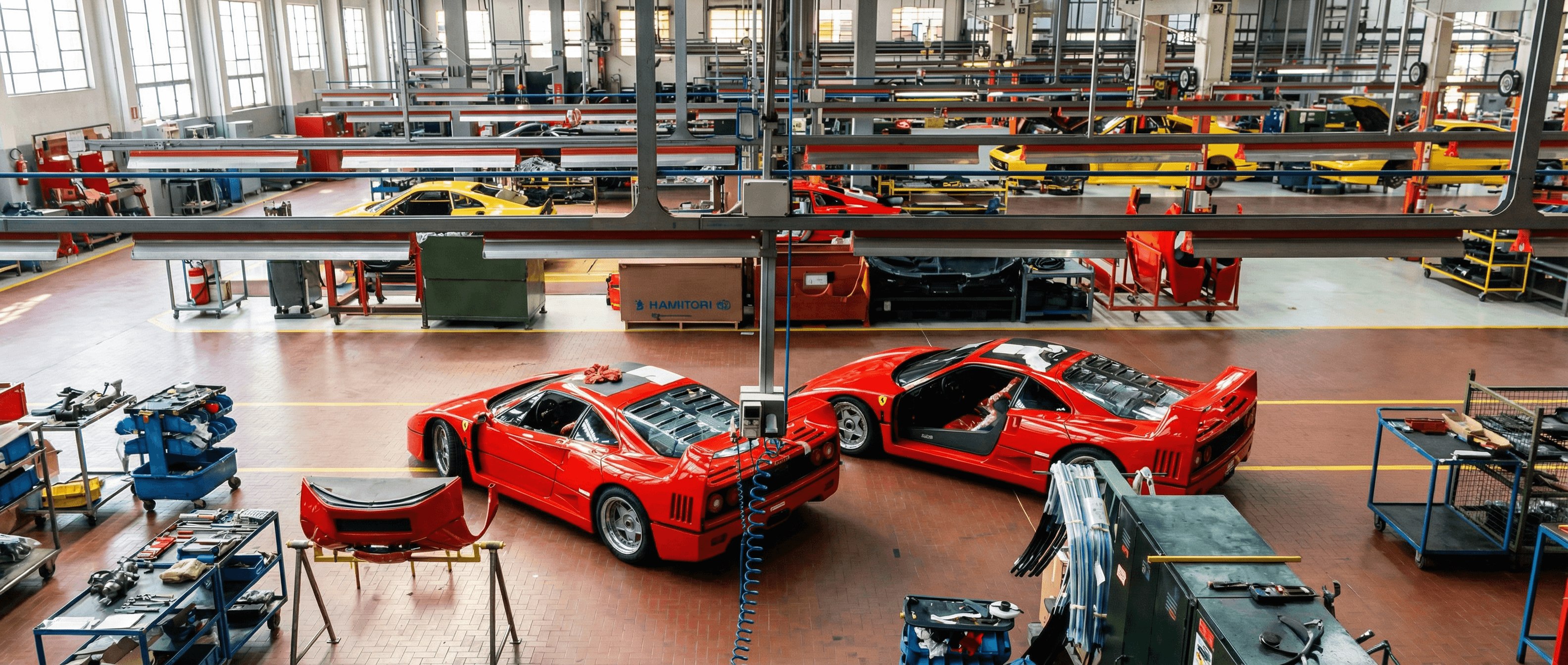
Driving an F40 is like holding onto a lit firework with a steering wheel attached. It does not flatter you. It does not relax you. It makes modern supercars feel like luxury hotel lobbies.
In music-video culture: one of the best-known non-track appearances is in Jamiroquai’s “Cosmic Girl” video, filmed in Spain, where the F40 used was reportedly Nick Mason’s. Top Gear also references Mason’s F40 being part of that shoot.
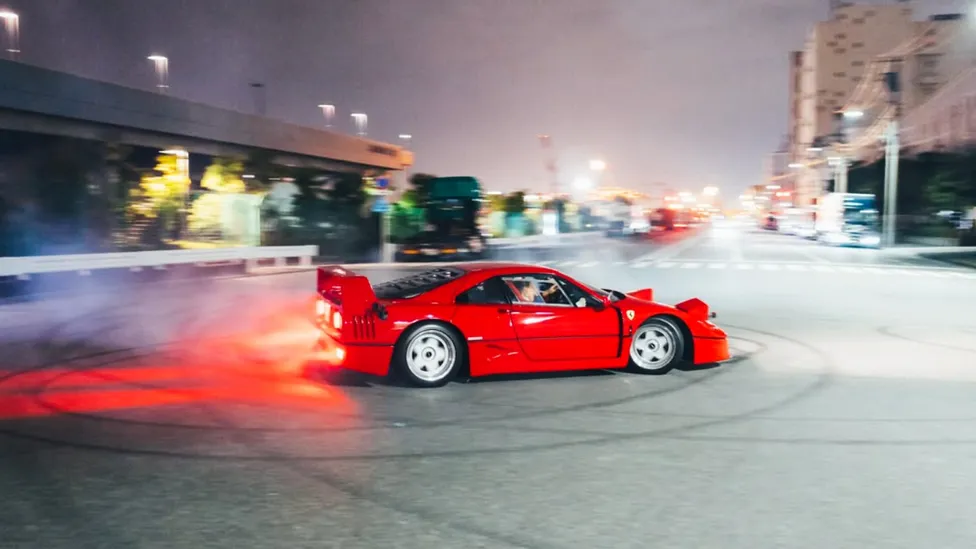
The F40’s magnetism has not faded with age — if anything, it has become stronger. Ahead of the 2026 Japanese Grand Prix, Lewis Hamilton was seen in Tokyo in an F40, and he did not handle it delicately. Footage showed smoke, wheelspin, drifting and donuts at Daikoku, as if the car had pulled him straight into its orbit. That is the thing about an F40: even in the hands of a modern Formula 1 star, it does not become tame or ceremonial. It still provokes mischief, theatre and a bit of danger.
Ferrari did not expect to build so many. Ferrari initially intended to make about 400, but production ultimately went to well over 1,300 because demand was enormous.
In 2026, a standard Ferrari F40 is generally trading at about $3.0M to $4.0M. At the very top end, exceptional cars can go much higher. A 1992 Ferrari F40 sold for $6.6M on January 17, 2026
share