
Ferrari
The Ferrari F40 and 288 GTO: Complete Guide to Ferrari's Legendary Twin-Turbo Supercars

Introduction
A generation ago, the fastest road cars — many of them Ferraris — were spin-offs from the race circuits. Since then, the technology gulf between road and track had grown steadily wider. Or at least, that was the way road car development looked until the arrival of the Ferrari F40 in 1987. With breathtaking bravado, Ferrari launched this street-legal racing machine as the fastest road car ever seen.
The F40 is the first car for public sale capable of exceeding 200mph. And it gets there faster than any rival: it can accelerate to 60mph in 4.5 seconds, and to 120mph in 11.5 seconds. Naturally, it has handling to match its outrageous speed. Only the Porsche 959 comes close to the F40's capabilities, yet around Ferrari's tight test track at Fiorano, a 959 is reckoned to be 10 seconds a lap slower.
Ferrari has accomplished this superiority over all comers by using racing experience to pack a formidably powerful engine into a lightweight chassis carrying race-bred suspension. The F40 is truly a racing car for the road. Indeed, so much have racing requirements dictated the car's design that a customer need do little more than kit himself out in helmet and overalls to take his car to the grid.
At the heart of the F40 is the most powerful engine ever fitted in a road car, ignoring the work of specialist tuners. A 2.9-litre V8 carrying twin turbochargers produces 478bhp — 20 per cent more than the GTO from which the F40 is derived. Even the rather heavier 959, a 197mph car, has to settle for 450bhp. Ferrari claims that another 200bhp is comfortably available for racing versions by making relatively simple modifications.
Putting its power through a five-speed gearbox, this engine sits in an advanced chassis which uses composite materials — Kevlar, carbon fibre, glass fibre and Nomex — bonded to a steel frame to save weight and increase strength. The resulting rigidity, and the handling finesse it promotes, is one of the most impressive qualities you discover when driving an F40. The stunning bodywork, the work of Pininfarina, is also made from composites. The most powerful of all supercars is also the lightest.
The F40 arrived at a time when the supercar market was more buoyant than ever before, earning itself instant investment status thanks to great demand from Ferrari customers. It really is a very special supercar.
The GTO: The Beginning
The development path which led to the F40 began when the Ferrari GTO was publicly revealed at the Salon International de l'Automobile in Geneva on 28 February 1984. Amid a seething mass of onlookers, the dust covers were whipped from two examples of the new Ferrari GTO at 5pm precisely. This was the moment when the world first saw one of the most spectacular street-legal Ferraris ever produced.
Throughout its existence, Ferrari has traded on expertise gained from motor racing in developing its road cars, although the relationship between the two sectors of Maranello's business became progressively more distant with time. Ferrari had not been officially involved in endurance sports car racing — historically the more significant source of cross-fertilisation — since 1973; and the increasingly rapid development of Formula One technology had become largely irrelevant to road car engineering. Or at least this was the way it seemed until the GTO's arrival.
The GTO showed that the old adage 'racing improves the breed' is still appropriate. Two of the most vital factors in its towering performance — the rigidity and lightness of composite materials in the body, and the engine's twin turbochargers — were drawn directly from racing experience. And with the F40, the GTO's spiritual successor, the links between road and track were pulled still closer.
Mindful of this significance in its new limited-production supercar, Ferrari chose to give it a romantic racing title from the past. The original GTO — Gran Turismo Omologato — from the early 1960s is one of the most revered Ferraris of all time. As soon as word leaked out from Maranello that a fabulous new supercar named GTO, one which was to be homologated for racing, was on the way, anticipation among enthusiasts was aroused. If this new GTO was really going to be a revival of the original's concept, it would be a truly special car. Indeed, Ferrari judged the GTO's reception in Geneva as euphoric, matched only by the arrival of the Berlinetta Boxer.
It is worth noting that the new car is badged simply as the GTO, although it is often referred to as the 288 GTO. The numbers follow Ferrari's modern designation system, not the old cylinder capacity formula: they stand for 2.8 litres and eight cylinders.
The Group B Connection
The new GTO might never have come into existence but for a new structure of motor racing regulations. A category known as Group B was among a battery of revised rallying and sports car racing rules introduced in 1982 by the Fédération Internationale du Sport Automobile (FISA). In order to be homologated into Group B, eligible cars had to be series-production GTs with a minimum of two seats, built in a quantity of at least 200 over a twelve-month period. The idea could have been tailor-made for Ferrari: 200 super-exclusive road cars could be built relatively easily by such a small, flexible factory, with a further twenty or so manufactured for racing customers.
That was the theory, but things worked out very differently in practice. Although Group B was successfully applied to rallying, the track equivalent drew so little interest from manufacturers and privateers that it flopped entirely. Bulging order books ensured that Ferrari GTOs and Porsche 959s were nevertheless built to the required specification, but none found their way into serious circuit competition. While Group B rally cars — the Audi Quattro Sport, Ford RS200, Lancia Rallye 037 and Metro 6R4 — brought a dramatic era of World Championship rallying lasting until the end of 1987, the Group B Ferraris and Porsches became instant investments, cocooned in air-conditioned garages all over the world.
The GTO in Detail
At first sight you might take the GTO to be a relatively simple derivative of Ferrari's best-selling 308GTB. It has a more purposeful stance and its flanks swell out more voluptuously over wider tyres, but the shape is essentially the same. However, appearances are deceptive, for there is precious little similarity with the GTB beneath the surface.
The GTO's engine is derived from the 268C V8 which Ferrari produced in 1983 for Lancia's LC2 endurance racing coupes, which is in turn related to the standard production V8 found in the GTB, GTS and Mondial ranges. The cylinder block and heads are cast in Silumin alloy, while the block's aluminium liners are toughened by a coating of Nikasil. The crankshaft runs in five main bearings. Bore and stroke of 79.76 x 70.99mm give a displacement of 2855cc — a size calculated to fall just within FISA's 4-litre Group B class: when multiplied by 1.4 (the equivalency factor used to align turbos with naturally aspirated engines), the GTO has a racing size of 3997cc.
Four-valve-per-cylinder Quattrovalvole heads are used, with the pair of overhead camshafts on each bank driven by toothed rubber belts with tensioners. The included angle between each pair of valves is 33° 30'. Other details include a single-piece crankshaft and a compression ratio of 7.6:1. Separate Weber-Marelli fuel injection/ignition systems are provided for each bank of cylinders.
Apart from the 208 Turbo — the 2-litre tax-break version of the GTB for the Italian market — the GTO was Ferrari's first turbocharged road car, although the Racing Department had been producing Formula One turbos since 1981. While the Grand Prix engines used German KKK turbochargers, Ferrari rather surprisingly specified a pair of Japanese IHI turbochargers for the GTO, together with German Behr intercoolers drawing cooling air through two ducts behind the rear three-quarter windows. The two exhaust runs are linked by a balance pipe over the transaxle casing, feeding a central wastegate valve which exhausts above 0.8 bar.
The use of two small turbochargers was dictated by the need for progressive power delivery. Throttle lag — the perennial problem with turbos — can be reduced when a pair of compressors is used, since smaller blowers have less inertia and spin up more quickly on the exhaust gases. The decision to use IHIs was reached after extensive testing by engineers working under the direction of Nicola Materazzi. While Formula One experience showed that KKKs were ideal for producing sheer power, they delivered it in a sudden rush high in the rev range. The IHIs were found to offer the best full-range characteristics, with the widest power spread and the most flexible response for road use. The wastegate valve is set at 0.8 bar, yet even at 2500rpm the IHIs are already wound up to give 0.65 bar boost.
Peak power is given as 400bhp at 7000rpm, 750rpm short of the engine's limit. Tremendous mid-range performance is ensured by a torque maximum of 366lb ft at a relatively low 3800rpm. In a car weighing only 2557lb (1160kg), this power produces incredible acceleration — enough to make the GTO the world's fastest road car at the time of its launch. Ferrari's own figures are 0–100kph in 4.9 seconds and 0–200kph in 15.2 seconds. The standing quarter-mile can be achieved in 12.7 seconds, and the standing kilometre in 21.8 seconds. Ferrari quoted the top speed at 305kph (189.5mph), which in 1984 was comfortably faster than any other road car, including Ferrari's own 180mph Testarossa, launched in the same year.
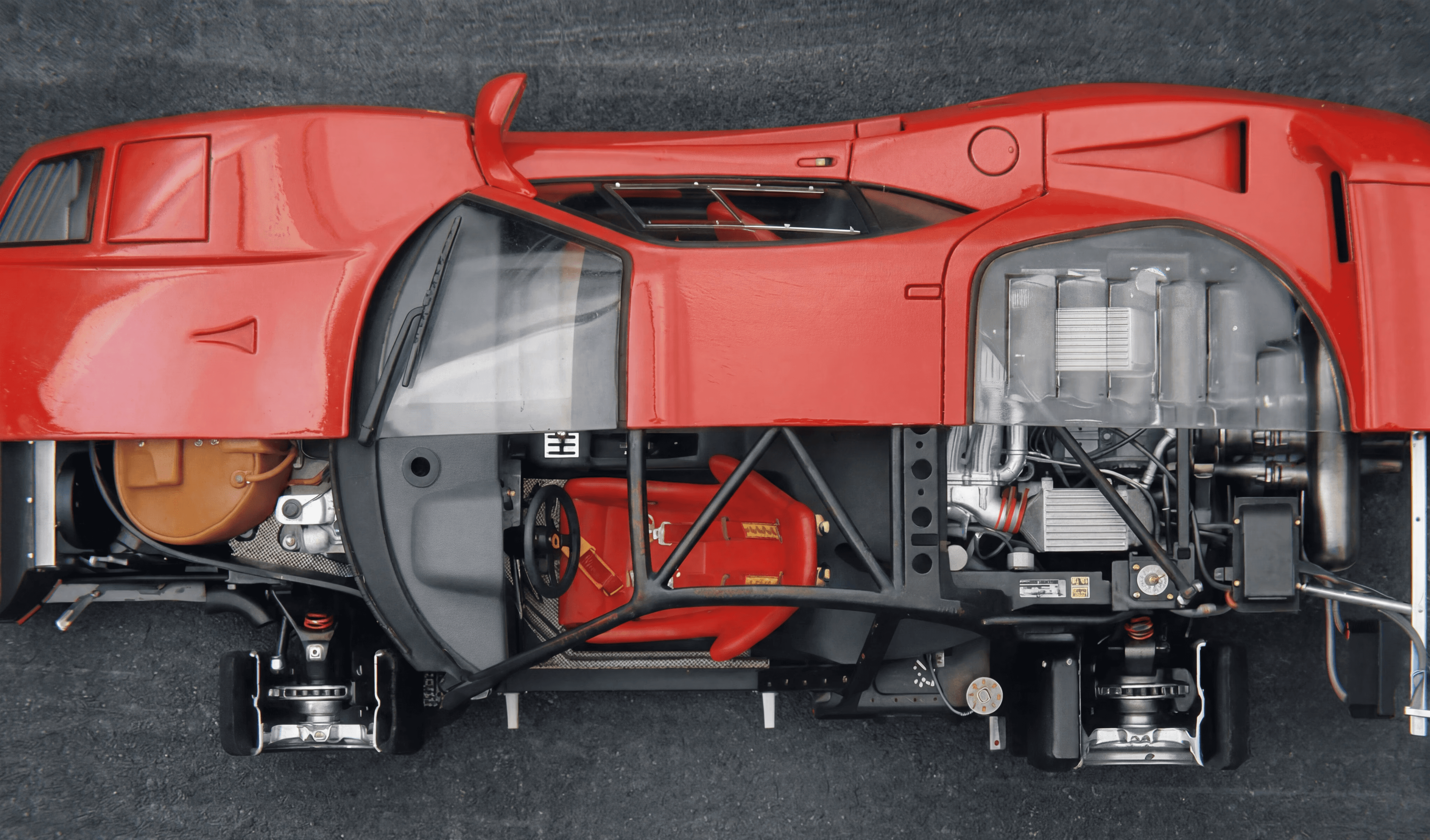
Raising the engine cover reveals the most fundamental difference from the GTB: the GTO's V8 engine, nestling beneath its turbocharging installation, is not mounted transversely as in the GTB. Instead it lies longitudinally, Formula One style, in line with a five-speed transaxle gearbox extending behind the rear axle line. This configuration allows the engine to sit so close to the centre of the car that the front half is tucked ahead of the rear window line, with only the rear four cylinders protruding into the engine bay proper. One benefit of this north-south layout is that the engine sits 2.8in (71mm) lower than in the GTB, appreciably lowering the centre of gravity.
Sitting directly behind the engine in line with the rear wheels is the five-speed transaxle, contained in a magnesium alloy casing. Drive is taken through an 8.4in (216mm) Borg & Beck twin-plate clutch — with hydraulic actuation borrowed from Ferrari's Formula One cars — to the gearbox, then through the final drive to a plate-type limited slip differential, and out through double-jointed, gaitered half-shafts. The transaxle layout accommodates a racing customer's need for quick ratio changes by making the idler gears easily accessible through the rear cover plate. All five ratios have synchromesh, although Ferrari originally planned to offer a non-synchromesh option for racers.
Chassis and Suspension
The GTO's high-tensile tubular steel chassis frame is a lengthened and heavily reworked version of the GTB's, with the wheelbase 4.3in (109mm) longer at 96.5in (2450mm). The structure incorporates a roll-over bar and provides two tubular side frames running either side of the engine/gearbox unit. The front track of 61.4in (1560mm) and rear track of 61.5in (1562mm) are both 4in (101mm) wider than the GTB's. Overall length increases by 2.4in (61mm) to 168.9in (4290mm).
Suspension basically follows GTB practice, with tubular steel double wishbones at front and rear, all but the upper fronts having diagonal bracing members. An anti-roll bar is fitted at each end, while Koni adjustable coil spring and damper units are used all round. To minimise overall suspension height at the front, the spring/damper units attach to the lower part of the hub carrier and feed loads into the chassis between the upper wishbone mounting points. At the rear, where suspension height is not so critical, the spring/damper units are attached to the top of the hub carrier and protrude up into the engine bay, bearing against chassis turrets just below the engine cover.
Steering is by rack and pinion, geared to give 2.9 turns from lock to lock, with a turning circle of 39.4ft (12.0m). Braking ability has to match the GTO's devastating performance, so new calipers — those at the front having four-piston operation for better initial bite — were developed jointly by Ferrari and Brembo. These clamp massive ventilated discs of 12.2in (310mm) diameter at both front and rear. A vacuum servo is included in the system. New Speedline split-rim alloy wheels with a traditional five-spoke design are fitted, the 8in front rims carrying 225/50 VR16 tyres and the 10in rears 255/50 VR16 rubber.
Styling by Pininfarina
As ever, the GTO's styling was entrusted to Pininfarina. A team working under Leonardo Fioravanti, Director General of Pininfarina Studi e Ricerche, used a standard GTB as their starting point. After lengthening the wheelbase by the required 4.3in, they experimented with various dummy panels until they achieved the right combination of aesthetics and aerodynamic efficiency in the Pininfarina wind tunnel. Fioravanti admitted that the most challenging aspect of the task was handling the change of proportion that resulted from the extra wheelbase length between the door and the rear wheelarch. His team coped well: the GTO's added length gives it an even more flowing line, which makes the GTB's classic shape look slightly compact by comparison.
The bulging wheelarches, needed to accommodate fatter wheels and tyres — the GTO is 7.5in (190mm) wider than the GTB — are beautifully proportioned, and the aerodynamic appendages at nose and tail are neatly integrated into the overall shape. The tail treatment is particularly elegant: a sharp flip-up on the upper surface and a row of three slots on each side behind the wheelarch deliberately echo the original GTO. The aerodynamic lip provides high-speed downforce, while those three slots are a design signature, mimicking the air outlets found behind the front wheelarches of the original 250 GTO. The nose is similar to the GTB's, except for larger auxiliary lamps and a more pronounced chin spoiler, also needed to generate high-speed downforce.
The air intakes scattered over the GTO's body are larger and more numerous than those on the GTB. The inlets at the front supply air to the water radiator, optional air-conditioning system and ventilated brakes. Three ducts on each side — along the doors, behind the side windows and in the sills — feed air to the intercoolers, the engine compartment and the oil cooler.
A Body of Composites
The use of composite materials for the body was one of the most significant innovations on the GTO, especially in view of the further developments that would come with the F40. The theory of composites is that different materials are incorporated into a single structure which makes the most of each component's individual qualities, so that the panels created are both stronger and lighter than any metal equivalent. Composites played a big part in bringing the GTO's kerb weight down to 2557lb (1160kg) — 227lb (103kg) lighter than the GTB — despite the GTO being a larger car with a mechanically heavier twin-turbo installation. The further advantage of reinforced plastics is that they do not deteriorate: a GTO's body should last indefinitely.
This composites technology was a direct spin-off from Ferrari's Formula One programme. The Racing Department began to explore composites in 1982 with the 126C2 chassis, leading to the development of successive C3 and C4 models. One of the chief reasons Ferrari recruited English designer Dr Harvey Postlethwaite in 1981 was his expertise with modern materials. Throughout its decades in Formula One, Ferrari had always been seen as a racing car manufacturer which bolted tremendous engines into relatively primitive structural hardware, its race-winning streaks coming when sheer power and driving ability overcame the chassis superiority of its predominantly English rivals. Brought in to address this traditional shortcoming, Postlethwaite installed the facilities — including a large autoclave for moulding composites — necessary to work with reinforced plastics.
The production department watched the Racing Department's activities closely. They realised that the GTO was their opportunity to apply this new knowledge to a road car, to experiment with expensive techniques which would have major technological implications for the future if the cost could be brought down. At this stage, composites — still in their infancy at Ferrari — could be considered only for the limited-run GTO, not for series production.
Postlethwaite's experience in forming racing monocoques from carbon fibre, glass fibre, Kevlar, Nomex, light alloy, epoxy resin and adhesive composites helped solve problems of rigidity, weight, noise suppression and heat isolation on the GTO. While the body was moulded essentially using advanced glass fibre technology, some components benefited from the most pure Formula One know-how. The bulkhead between the passenger compartment and engine was the most elaborate, comprising two layers of Kevlar/glass fibre composite sandwiching an aluminium honeycomb core; this bulkhead acts simultaneously as a rigid structural member, a firewall and an insulating layer. The ultra-light front bonnet lid (weighing just 7lb/3.2kg — too light to be slammed shut), roof panel and rear deck were also moulded in Kevlar/Nomex composite.
For all its visual similarity to the GTB, the GTO's composite body is one of the most important differences between the two cars. The only body parts they share are the steel doors and the windscreen. As well as simplifying the GTO's manufacture, retaining the existing doors made sense because their inner intrusion barriers had already passed crash test requirements in all world markets.
Driving the GTO Almost No Turbo Lag
Opening the GTO's door reveals a cabin that could be taken for a GTB interior by all but trained Ferrari-spotting eyes. There are plenty of differences when you start to look around, but the first impression is of a familiar GTB environment: the same doors, windscreen and instrument binnacle, the latter perched like a large orange segment on top of the fascia, which is trimmed in a black velvety material to prevent distracting reflections in the windscreen.
The seats, fairly flat in design, are very different from a GTB's leather chairs. They are formed from Kevlar/glass fibre shells covered with black leather, and like earlier Ferraris the leather is studded with rows of chromed eyelets to provide ventilation. The interior could not be described as luxurious, nor even entirely in keeping with the GTO's price tag, but it looks positively lavish compared with the spartan style of the F40: black carpet covers the floor and there is even space for the optional stereo radio/cassette.
Two large dials dominate the instrument pod: a 320kph speedometer and a 10,000rpm tachometer (red-lined at 7750rpm), flanking smaller gauges for oil pressure and turbo boost. Angled towards the driver on a minimal centre console are three further instruments for water temperature, fuel level and oil temperature. The usual three control stalks are on the steering column. The gear lever sprouts through Ferrari's familiar stainless steel gate, with the same slender, bent stem topped by a black knob as the later GTBs.
The driving position is comfortable and reasonably free of the old Italian long-arm, short-leg syndrome, although a driver over six feet might find himself short of seat travel. The small Momo steering wheel, with a chunky leather-covered rim, is pleasant to hold. Visibility, especially through the rear-view mirror, is good for such a low-slung car, although the windscreen pillars and rear buttresses create front and rear three-quarter blind spots.
The fact that this car is a cut above the GTB makes itself felt as soon as you start the engine. The note from behind your ears is quite different from the naturally aspirated V8's metallic rasp: instead you are treated to a more mellow sound, a muffled burble characteristic of a turbo, but with enough vocal presence to remind you of what lies behind. After allowing everything to warm through — including the gearbox, which balks into second when cold — you can begin to explore the realms of exhilaration unleashed by a little more pressure on the throttle.
Of course, there is quite astonishingly vivid boosted acceleration above around 3500rpm, yet the most impressive and surprising aspect of this twin-turbo V8 is how flexibly its performance swells up. According to the power curve, the engine develops 85 per cent of its maximum at 3500rpm, and improves thereafter. Power arrives with a strong surge once the turbos are spinning furiously, but it is delivered with remarkable progression — flowing evenly and fully, without a savage kick. Off-boost performance, with just a brush of the foot on the accelerator, is lively enough to match any common-or-garden supercar; but when the boost needle begins to flicker at around 2500rpm, the strong push begins. The turbos start to hiss, the engine note hardens, and the GTO catapults forwards at a staggering rate, almost too quickly to take in.
As you give the car its head through the gears, the figures help clarify what dizzying speeds are achieved in this pulse-quickening, adrenalin-pumping rush. The GTO will exceed 50mph in first gear, goes on to 85mph in second, 120mph in third; only at 155mph do you need to change up to fifth, which will take the car on to a 170mph cruise, a 180mph gallop, and finally close to 190mph flat out.
This lofty performance cannot be fully realised even at a tight test track like Fiorano, let alone on everyday roads. You need perfect conditions and an empty strip of tarmac stretching far ahead even to contemplate more than half-throttle, so much space does this king of Ferraris need to be exercised in anger.
For all this, the GTO is docile. It is smooth and sweet, refined and vibration-free; even the wail of the engine and wind noise are reasonably restrained. It is happy to be driven at one-tenth of its potential — which is just as well, because it would otherwise be virtually unusable. Except for its gearchange and sharp clutch, it is as light and easy to control as any humble family car. Care needs to be taken to ease the clutch through its biting point, and the gear lever needs sharp pulls and pushes from the shoulder, but in every other respect the GTO answers to a delicate touch.
The steering is light and precise, and so effortless as you twitch the car through a turn that you would expect power assistance; only its weight when manoeuvring reveals that there is none. The brakes are so capable and so solid in their response that you never have to think consciously about using them. They act progressively to foot pressure, without vibration or fade, effortlessly scrubbing off speed at a light touch, yet stopping the car full-square in what seems a matter of yards when you squeeze harder. You need the security of massive braking power when driving a car of this potency, and this the GTO gives you.
There is enough compliance in the suspension to give a ride quality which contributes to the GTO's relative refinement, yet the precision and tautness of the handling are worthy of a racing car. On the road it is rarely possible to feel any movement in the car's attitude, cornering being achieved with a totally undramatic, steer-as-you-point-it composure and a complete absence of roll. Even when pushing through a medium-speed corner with a good slice of the power tearing into the rear wheels, the tyres — larger at the back than the front, of course — keep their limpet-like grip, holding the car true to line. Through a tight hairpin, the front end's tendency to drift wide can be neatly balanced by power oversteer, but on open roads it is difficult to provoke movement from the rear wheels in any gear. With the restraint that public roads enforce, it is impossible to force the GTO's chassis into revealing any imperfections. Even when you judge that you are driving as fast as seems safe, the car seems to leave you with vast margins of grip, its poise unruffled.
The GTO's qualities are those of any Ferrari, but raised to new heights in a car which provides a sublime driving experience — one which was definitely unmatched when the GTO was new. In moving on a step further to the F40, Ferrari had only its own target to beat.
The GTO's Legacy
The GTO seemed at the time of its launch to be a bold statement of Ferrari's technological prowess. Just as the world's great automotive styling houses produce occasionally startling prototypes to demonstrate the innovation of their thinking, so Ferrari saw in the GTO — a racing spin-off — an opportunity to show just how substantially the limits of road car performance could be redrawn. The fact that the racing programme which prompted the GTO's development never materialised did not make the project any less worthwhile for Ferrari. But apart from being a new road car flagship, the GTO was a good earner too.
While the original plan was to build the required 200 for sale to customers and a further twenty for serious competition, things worked out rather differently in practice. The twenty racers were never built, and huge demand for the road-going version led to a total of 278 eventually being manufactured — 41 in 1984, 230 in 1985 and 7 in 1986. All were collected from the factory by their buyers, as it would have been uneconomic and unnecessary for Ferrari to put the car through the different homologation procedures required to sell directly in export markets.
Many customers ended up paying considerably more than the originally quoted cost, but none complained about the 194,166,000 lire (around £90,000) price tag. It is a mark of the GTO's exceptional qualities, even by Ferrari standards, that an example is today worth getting on for ten times its original price. The F40 looks to be heading the same way, towards instant classic status.
Indeed, the level of interest in the GTO so astounded Maranello's senior executives that the go-ahead for the F40 was a mere formality. Together with Porsche and its 959, Ferrari had been responsible for opening up a booming market among the world's wealthiest people for ultimate supercars. Today, at the start of the 1990s, a staggering range of rivals are jumping on the bandwagon, from giants like Jaguar and Chevrolet to tiny manufacturers like Bugatti and Cizeta.
Never in the entire history of the motor car have more people wanted to buy machinery at the peak of the performance league, yet never before have such cars been more irrelevant to daily motoring. None of the modern crop of supercars can be used to their full potential on public roads anywhere in the world, even on Germany's unrestricted but traffic-laden autobahns.
Investment is the key to this exciting aberration in the modern motor industry. The sheer romance and exhilaration of owning such an exotic supercar can never be doubted, but if you have the wherewithal to indulge in a somewhat impractical luxury, it helps to know that you would see a return on your investment if you ever had to sell. This phenomenon — whether temporary or permanent, who knows — undoubtedly explains why so many people want to buy supercars right now. Once upon a time, exotic sports cars depreciated just as savagely as the general run of the market, but now GTOs, F40s and 959s have made their mark as a sound alternative to the stock market. This is a simple assessment of the GTO's success: it opened up a new niche in Ferrari's rarefied market, leading the company to develop a successor — the F40.
The Original GTO: Incomparable Beauty
What pleases the eye is a matter of taste, but the pinnacles in any field — whether architecture, painting, sculpture or even motoring — generally produce near-unanimity when beauty is judged. A group of car enthusiasts may argue for hours about the world's most beautiful machines, but a handful of automotive greats will inevitably win approval. No one would question the beauty of a Jaguar D-type, a Lamborghini Miura, a Bugatti Type 35... or a Ferrari 250 GTO.
The original GTO is, quite simply, one of the legends of motoring history. Many Ferraristi consider it the greatest Ferrari ever made. Apart from its magnificent racing pedigree, its lines — a startling combination of grace and purpose — are quite wonderful to look at. Yet one of the surprises about the GTO is that it was shaped in-house at Ferrari, breaking with the pattern, as fixed thirty years ago as it is today, that bodies were styled by Pininfarina. Unknown engineers decided the GTO's lines, letting function dictate form. Indeed, the story goes that no drawings were made until after the first GTO had been built.
The GTO's bloodline reaches back to the 250GT of the 1950s — the family of 3-litre V12 cars which were effectively the first series-production Ferraris. The most charismatic road car available to wealthy buyers at the time, a 250GT was also a superb tool for winning GT category motor races. Among its successes was a run of four consecutive victories, 1956–59, in the Tour de France, a 3,000-mile marathon demanding speed and strength to survive the roads, race tracks and hill climbs that comprised the five-day event. The derivatives which achieved this were given the nickname '250 Tour de France'.
A shorter-wheelbase, more race-oriented version of the 250GT came in 1959 in response to the FIA's new GT category in the World Sports Car Championship. A little stubbier but no less sleek, the 250GT SWB cleaned up almost everything in the GT class, as well as taking two more Tour de France wins in 1960 and 1961.
Radical rule changes were on the way during the 250GT SWB's racing career, as the FIA planned to turn the World Sports Car Championship into the preserve of GT cars — not sports prototypes — from 1962. Knowing that there was plenty of life left in the 250GT SWB, Ferrari set a team led by Giotto Bizzarrini to work on producing a further-developed version — which would come to be called the GTO, for Gran Turismo Omologato — to take on potential rivals like the Aston Martin DB4GT Zagato and Jaguar's lightweight E-types. Close attention was paid to aerodynamics, partly to cure the SWB's tendency to lift at high speed, and the GTO thereby earned its beautiful form.
There was nothing radical about the GTO: it was just a carefully crafted derivative of the existing hardware, using Ferrari's familiar mechanical building blocks. Power came from the 250GT's 60° V12 engine, modified to Testa Rossa racing specification. Displacing 2953cc from a 73mm bore and 68.8mm stroke, it developed 290bhp at 7400rpm. No other street-legal car could boast close to 100bhp per litre at the time, and even today this specific output is beyond any naturally aspirated road car. Two valves per cylinder were operated by a single chain-driven overhead camshaft on each bank. Six twin-barrel Weber 38DCN carburettors were mounted in the vee, feeding twelve inlet ports. This magnificent power unit was mated to a new five-speed gearbox. Suspension was independent at the front but continued to use a live axle at the rear.
In order to be homologated for the GT category, the rules stated that 100 cars had to be built. Only thirty-nine GTOs were actually made, with Ferrari arguing that existing SWBs could be considered as making up the numbers, since the GTO was only a 'mildly modified' version. Whether this was blatant rule-bending or just imaginative interpretation matters not, for the GTO was declared legal despite protests from competitors. It proved fabulously successful in competition: fast and almost indestructible, a logical development of the SWB with everything put right.
Ferrari won the World Sports Car Championship three years running, in 1962, 1963 and 1964, with the GTO and the revised GTO64. Of the twenty-eight championship events held, the GTO won twenty, finished second in fifteen and third in nine. Thereafter, Ferrari turned to rear-engined sports racers, leaving the GTO as the last of the great line of front-engined V12 racing Ferraris.
share